
In previous parts I covered the basic strategy and all the choices made to support this: hosting, design, content management, audio, and news.
In the final post in this retrospective series I’ll talk about audience growth, transformation, and summarise some takeaways.
This is the critical part of my story. If you cannot increase the size of your audience to the point of economic feasibility then you might as well quit. By feasibility, I mean by way of profit for a commercial company, or some reasonable measure of value-for-cost in a non-profit context.
By the same token, if you cannot align the organisation to support the strategy, there will likely be too many barriers to success.
The strategy needs to link product, technology, content and marketing together in a cohesive, self-supporting matrix. You cannot grow the audience without these elements being integrated and collaborating effectively as they work towards the vision. Yes, silos are bad.
A good strategy places the organisation in the field of play in a way that minimises competition, although some overlap with competitors is inevitable. The degree to which you can differentiate dictates the size of the addressable uncontested market.
Media websites have a problem in this regard: the public has certain expectations based on what they see on other sites, and they also have a choice of where to read vast amounts of undifferentiated content. This is content that is, for example, based on press releases, or from an event that everyone sent a reporter to cover.
In the NZ Landscape, all of the large media websites cover politics, major business stories, crime and so on. That is the cost of playing in the general news category. The value proposition is largely unvarying between providers; there is little differentiation. Some people will find some sources of this content more trustworthy. This will usually be for reasons that are hard (but not impossible) to discover. It is worth discovering, which I will cover in a future post about understanding the customer better.
There are always scoops too, but with content sharing arrangements the advantage is small.
Some growth will come from audiences shared with, or won from, other providers. The greatest potential are the uncontested spaces where no one plays.
In a broad category, any new innovations are quickly copied. For example, as soon as one site started adding tweets into stories, all sites were doing it. As soon as one site started writing content based entirely on tweets, everyone was doing it. (Setting aside the argument that most stories based entirely on tweets are cheap filler content.) Get me an infographic, quick…viral content, FTW!
So, as we put together a strategy, how do we differentiate? Do we do it by having the best niche content? Do we strive to have the most comprehensive coverage of particular events? Do we add daily news podcasts or interactives? There are a lot of options to choose from.
Examples of niches in the New Zealand market include interest.co.nz and nbr.co.nz.
Bernard Hickey’s excellent The Kākā has carved out an important place in the news landscape doing ‘Public interest journalism about NZ’s housing, climate and poverty crises’. That is what innovation looks like.
Larger operations The SpinOff and Newsroom have also innovated and carved out space for themselves. Collectively, they all prove that there is room for innovation and that those offering unique content can have viable businesses and grow audiences in a competitive market.
To win, a general media site has to cover all the basics at least as well as everyone else, and beyond that offer something that is unique and valuable to visitors.
One question we might ask is this: can we cover the basics in a way that is innovative, and adds significant value to customers?
We could, for example, provide a radio bulletin style email news summary, with links to the full article. In essence, a ‘short read’. Another might be to do the same on a web page, providing a curated summary (a few sentences) of the latest news. This is different from current home page approaches with a headline and summary; this is fast news for people in a hurry.
On news sites, most new ideas last a week if you are lucky. Deep innovation is easier to defend (though it is often costly) and a great differentiator. Examples are the interactives produced by The Washington Post, The New York Times and others.
Some other ways to differentiate:
- be the fastest
- be the most comprehensive
- find unique angles on stories
- tell the story in a different way (e.g. through pictures, interactives, first-person narratives)
- offer better commentary/opinion.
Sometimes outrageous or divisive opinions are used as a differentiator. Some people just can’t get enough of the shock-jocks.
Alongside the considerations already listed, we looked at trends overseas. There was a lot available publicly, and some interesting reports from the likes of The New York Times, The BBC and others on the challenges facing digital. All of this information was fed into the mix along with local market research.
Growing the Audience
Against the picture I have painted above, and everything we put in place— technology, business systems, production techniques, etc—how did we grow the audience?
A big challenge for us was that most New Zealanders had already developed a solid habit of using the Stuff and/or NZ Herald websites for their online content. They were not likely to switch to us, even if they knew we existed. My theory was that they would eventually sample RNZ, and develop a secondary habit, and that we could build off that base.
Radio NZ had something else unique: a lot of great audio story-telling. But if no one knows it is available, how do we grow?
There were (and are) three broad categories of potential audience. The first are the ‘friends’ group. This will be an audience who you already have a relationship with; they are like the people who live in your street, and your family.
For RNZ, the ‘friends’ group were represented by the existing radio audience, and they were easy to reach: “If you want to listen to that interview again, you can visit our website.” On-air promotion of the website became a vital component in bringing the existence of the website to their attention.
This is something we could have done more of, and earlier, but it is fair to say that some staff and management still did not think it was worth investing any effort into the website. There was also a concern about tiring listeners out by constantly promoting the website.
As internal capability and confidence with the web grew, programmes promoted the site more, and also directed the audience to associated content: “if you want to see a picture of what we are discussing, go and visit our website”. This kind of promotion, which shows a current and immediate benefit, is always the most effective.
To support this we set up short URLs for all programmes to use on air, for ease of reading out. “Ar en zed dot co dot en zed slash national slash programmes slash nine to noon” was replaced with “ar en zed dot co dot en zed slash nine to noon”. Much easier to say than to type!
That’s another advantage of a custom CMS: we were able to add a custom module to create and manage these short URLs.
The second group of potential audience are ‘neighbours’. They know about you, but they are like the people you see regularly in your local shops who don’t talk to you unless you give them a good reason to.
This group is generally reached via social media, or via first-hand referrals, both being based on communities and the connections between people.
The last group are the ‘distant’, out of sight, out of mind people who never listen to RNZ, and may not even be aware that there is a website or something that would be of value to them.
The approach with this group was to rely partly on social media sharing to break out of the bubble—from my neighbour, to their neighbour, and so on. The primary approach was to use technical SEO to ensure that our content got a high search ranking and good visibility in Google News. We did see increases in traffic from both sources in repsonse to early efforts in this area, but we did not have any way (initially) to know if they were non-radio visitors.
Later, various promotions were designed, many with the help of external agencies. This included the Kiwiana radios, occasional newspaper and TV advertising, and a billboard campaign in Auckland. There were some duds too, like the ‘sounds like us’ on-air campaign in 2007, which was dropped after a couple of weeks.
As the number of visitors grew, another challenge arose: how do we get them to spend more time, and to share more with their networks. That’s a problem every site in the world has. In our case, there were several responses to this problem.
The first was to improve the reading experience and increase the visibility of related stories, making it quick and easy to click through. Typography and design are a key part of the reading experience, right down to minutiae such as line-spacing and how links are styled. That, and dozens of other small factors, contribute to a good polished experience for the visitor, and make it more likely that they will be inclined or influenced to share. With each new design we tryed to solve a new group issues, and then built on that incrementally.
The second was to make it easier to share stories via social and email directly from the site. This wasn’t about making the share buttons as big and obnoxious as possible (which someone did suggest), but about understanding when the reader would be ready to share, and making it easy to do so at that point. We worked hard to understand user behaviour on the site, and worked to make this as smooth, pleasant and unobtrusive as possible. A nudge at the right time is always more effective than a bullhorn at the wrong time.
My team would also regularly take calls from the public who were struggling with some task on the site. This was used as a chance to learn something about their experience, and apply it in improving the experience.
The technique I used, even for these short calls, was to ask the caller to describe what they were trying to do, and why they were trying to do it. The what and why are very important questions because they expose what progress the caller was trying to make in using the site.
These insights were converted into changes to the site, especially when patterns emerged. Sometimes a label might need to be updated. Perhaps some linking text wasn’t clear enough. Maybe we’d offered the wrong service completely?
One quick example was the print options available in the schedules section of the site. Printing the page was not working for visitors. We found, from talking to callers, that these were mostly retired people who wanted to print the schedules (usually at the library) so that they could plan what they were going to listen to for the next week. They wanted to keep costs down because they had to pay per page, but did not want them so small that they could not easily read it. With this knowledge we redesigned the entire print offering around auto-generated PDFs.
The actual content was obviously an important factor too. Better content results in greater engagement (time spent on site) and shareability. A lot of time was spent getting people up to speed, training, and working on making things as efficient as possible, and staff did a brilliant job of creating and adapting content for the site.
We knew that there was demand for audio content, to meet the needs of people who were unable to listen live, or who wanted to listen again, or share with a friend.
We also knew that being able to access Radio NZ News at any time, not just at the top of the hour, was going to fill a gap.
As time progressed, the approach to content was adapted and expanded to increase the value to readers. Web news went deeper into stories, photos were added, and later, related stories were added for extra context.
Video was also used, starting in 2014. Some early attempts were failures, and one in particular stands out. A crew was sent to video one of John Key’s post-cabinet press conferences, because “video is so engaging and lots of people will watch it because it is the PM”. It was edited and given the top spot on the home page. It bombed, getting fewer than 30 views in the first couple of hours.
That same week Our Changing World had posted a video of a science experiment on their programme page. It was not even linked from the home page, but got hundreds of views.
What was the lesson we learned?
The first video was based on an assumption about the content and a supposed righteous cause: this is important stuff, build it and they will come.
The second was focussed on adding real value to customers’ experience. The science experiment was visually interesting, referenced in the radio programme, and people flocked to see it, even weeks afterwards. It may have been this video of scientists hurling condoms filled with silly putty from a trebuchet to model the behavior of magma thrown out of erupting volcanoes, or perhaps this volcanic eruption simulator. Both are still worth watching. I’ll wait…
The PMs press conference? Yea, nah. I couldn’t even find it to link to for this post.
To be fair, this ended up being a good experiment to see what resonated with the audience, and the newsroom quickly adapted and subsequent attempts were more successful.Programme pages were also improved.
In 2008 we had just basic rundowns with just the broadcast audio. Like this:
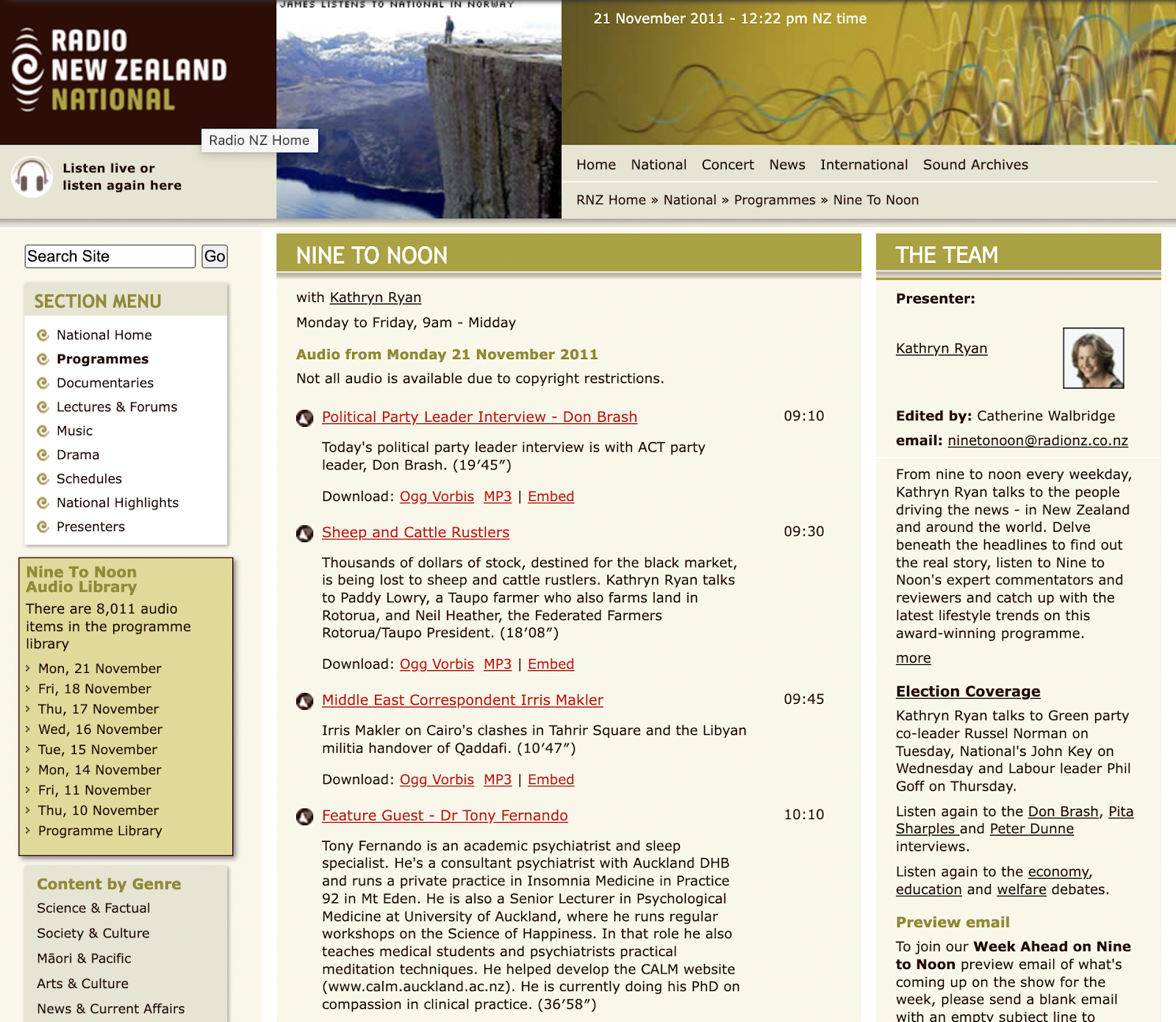
By 2016 we had added the ability to add images to audio items, and producers were putting a lot more work into their rundowns and adding more information to the audio stories.

Documentary content was also improved over this time. The first audio documentaries we posted had a title, a brief summary of what it was about. Over time these were augmented with a lot of extra material including photos, video, external links and longer narrative summaries.
Almost all published audio was available via a podcast feed, and we made it trivial to do this by making it a simple on/off in the administration section of the programme.
Audience research both fed into this work, and was used to track progress. My team did some qualitative research. Any time we had a member of the public call us for help, it was treated as a chance to find out more. RNZ listeners seem to love being put through to someone ‘working on the radio’ (or website), and would happily engage in conversation about what they were trying to do and why.
This approach—of being curious about our visitors, and asking them to talk us through what they were trying to do, and why—eventually led me to the Jobs To Be Done (JTBD) framework. The way we ‘interviewed’ callers was very similar to how radio interviews are conducted. The interviewer is there to elicit a story, and to be curious, asking more questions to broaden understanding. This was a very natural precursor to the style of interviews conducted for JTBD.
The quantitative research was by way of surveys, which did include some questions about website use. This was matched against web analytics to provide an idea of how many RNZ listeners were also website users, and (by inference) how many were not.
RNZ also added formal qualitative research covering many factors such as attitudes to RNZ, and these are published in their annual reports.
One other thing that emerged from my research was that audience behaviour was starting to shift away from live consumption towards on-demand listening.
This is a question that is facing producers of live media today: to meet this shift how much do you invest in the on-demand space, and how far do you go? Do you go so far as to innovate to the point of putting your live offering out of business?
There were early signs that even older audiences were making the shift to on-demand, and this was probably initially fuelled by their exposure to many video-on-demand services in family settings. This new-found technology confidence combined with the discovered convenience of on-demand would start to eat into what was once considered an unmovable audience (retirees). Just as I was preparing this post there is new data that shows we appear to have reached the live/on-demand tipping point.
From a strategy point of view, this trend was obvious, and linear broadcasters should have been preparing for it. As noted in point four of the linked story just above, TVNZ seems to have been ahead of anyone else with their efforts to shift their audience to the TVNZ+, impacting their live numbers. I would love to get a look at their strategy!
Viewed through the lens of the excellent book, The Innovators Dilemma, live broadcast is, a sustaining technology, while on-demand is a disruptive technology. The lesson to be learned (and which TVNZ seems to have followed) is to disrupt yourself before someone else does.
There is another aspect to the three broad groups of audience defined above, and that is that within each of these three groups there are five types of consumer—innovators, early adopters, early majority, late majority and the laggards.
The innovators will give anything new a try and will be very resilient in terms of handling bugs or problems; they just want to be first. Early adopters prefer to wait until the bugs are sorted, but like new experiences. The two majority groups will dive in once something starts to get established; the early majority will have friends who are innovators or early adopters. The laggards will be resistant to the change, and will often hold out until they have no choice left.
Understanding how each group (friend, neighbour, or distant) and type works is vital in getting a sense of how much effort is required to reach each group/type combination and what the value of each is. This is the important ‘cost of acquisition’ question, and it’s a very important one because some potential customers are simply not worth trying to acquire. There is a laudable no-one-left-behind philosophy in public media, and a good strategy needs to reconcile this important value against the actual funding.
While I have presented the customer space as a three by five matrix—which is certainly a manageable way to think about things—it is actually two intersecting continuums with a nearly infinite number of permutations. And beyond that, every person has their own context and goals that are the motivations behind what media they consume. So while there is no single answer, there will be findable solutions that deliver value to reasonable numbers of people.
As you move from friends to neighbours to distant, the cost to acquire goes up. Likewise, early adopters are cheaper to acquire than laggards. The laggards in the ‘distant’ group will usually be the most expensive to acquire.
Once you have largely exhausted acquisition in a particular group, we will reach a plateau.
At RNZ we saw a number of plateaus caused by this effect, and I had to rethink our strategy each time. The big change in SEO techniques in 2014 is one example of such a response, with this seeing a major uptick in traffic that was sustained for years.
Other plateaus were caused by limits in the content we had on offer. For example, the 2005 release of the site was great if you were a Nine to Noon fan who wanted to catch up on missed interviews. It was useless if you wanted to listen to Spectrum, Insight, or any other documentary.
Of course, you cannot keep all of the people happy all of the time. Strategy is about making choices; we cannot do everything we want to. Trying to do everything causes a lack of focus in the organisation, because suddenly everything is a priority, which means nothing is.
As I indicated, once any company has reached a plateau, then changes in the strategy may be required. Individual initiatives might give short-term results, but this will fuel false hope. The strategy needs to be rethought and rebalanced for the current context.
Other examples of plateaus, albeit smaller ones, were after we started sharing data with The National Library and the embedded player was launched and used on the fabulous Audio Culture. There was also a content sharing arrangement with msn.com in Australia in 2015. There was an initial uptick in traffic from each of these, which then settled back into the background noise of organic growth. I’d imagine that the same effect happened after RNZ widened content sharing with New Zealand websites.
There was one thing missing from our approach to content: a much deeper general understanding of how it adds value for the perspective of the consumer. We did have some understanding of the forces at play in some areas, but I think the overall approach lacked the sophistication necessary to really make an impact and maintain momentum. There never was a company-wide unified approach to understanding the progress our visitors wanted to make, both on-air and online, and applying this to problems across the business.
After the establishment of a separate digital team in 2015 there were improvements in terms of focus and drive, and a shift to producing more, and better, content. The separation resulted in some siloisation, and the chance to shift the customer engagement paradigm also passed.
Supported by the SEO improvements cited above and other factors, the number of people enjoying RNZ’s great content continued to increase online, and given that RNZ still had limited funding from 2016 until today (2023), it is impressive that they were able to sustain some audience growth.
Social Media
Initially, there was not much thought put into social media, and I have to take some blame for that. I was not a fan of Facebook for reasons I’ll share below, but I was an early adopter of Twitter.
Differentiating yourself on social media is expensive. It requires dedicated people who are excellent curators, and who can apply high emotional intelligence in their responses to tweets and comments in feeds.
Automated feeds only get you so far as each kind of social media has its own style, and automated posts just end up looking like bland content marketing, and become ‘visual noise’ which is ultimately ignored.
Great strategy is about making choices, and social media can be a massive cost for not a lot of real return, audience wise. Much better to do a little and do it very well.
Some programmes had set up their own social pages quite early, and we later had to do some follow up work to standardise naming and provide guidelines for use.
Of the programmes that started their own Twitter accounts or Facebook pages This Way Up was one of the most successful. Their feeds were well curated and their somewhat quirky approach was in keeping with the personality of the show and host.
RNZ had two main Twitter accounts. @rnz_news, which was an automated feed of any news stories in the ‘top’ news category, and @radionz. The latter had been set-up in 2009, but was not used at all until 21 February 2014 because of internal arguments about what, and how, it should be used. This was driven by a very conservative view that the main RNZ social media needed to be ‘corporate’. When Paul Thompson arrived he gave the go ahead, and I ran the account, supported by a few others for the first 18 months or so.
The approach was obviously very important, and the first tweet asked people what they wanted from the account. Even after there had been no activity for years, there were a few thousand followers.
‘Corporations struggle with twitter cos they so boring [sic]. Drop the corporate’, was one early answer, with other people suggesting interaction, breaking news, and a mix of interesting stories.
OK, so not corporate, not boring.
The ultimate intent in posting to social media was to try to break out of the bubble of our regular audience with the hope of others finding out about the content. Basic marketing, really, but it also had to be entertaining.
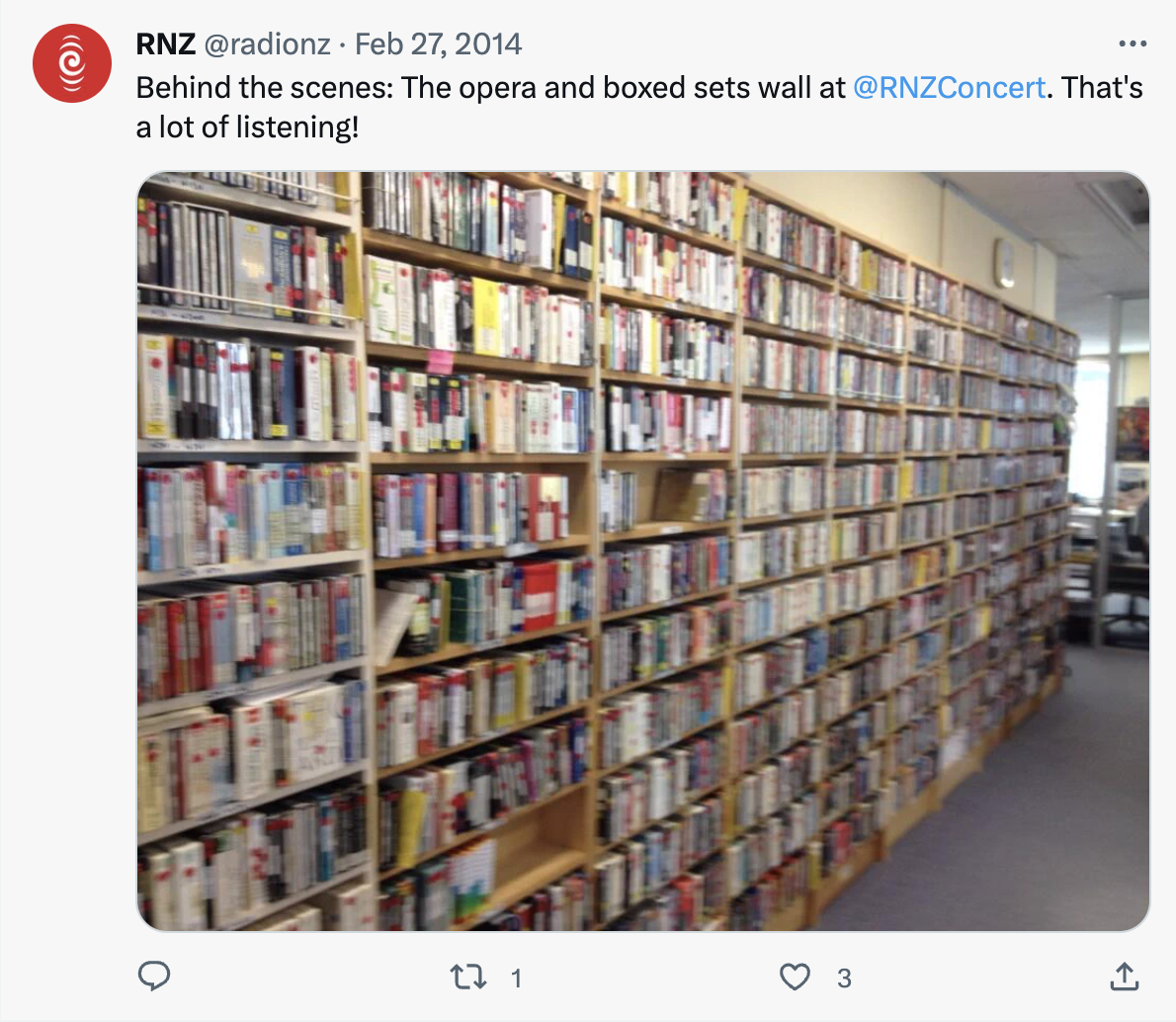
‘Behind the scenes’ was one initiative, an ongoing occasional series that built up quite a following. Some of the numbers on these examples were higher back when they were posted. People seem to have left Twitter for some reason…
Humour was also used, and in one case I asked people what they thought about using Comic Sans for a redesign of the site, and then posted a mock-up using live content.

Another approach was what we called ‘alternative commentaries’. When a serious sports event was being live tweeted on the @rnz_news account, I would provide a ‘different view’ of the event on @radionz.

And there was always the odd chance to capitalise on typos made by staff, with reference to a local meme.

There were a lot of tweets to stories as well, but we avoided most news as this was covered by the @rnz_news account. The stories were an eclectic but interesting blend, selected by my team, with the aim of creating delight.
The “professionally casual with some humour” approach was successful, growing the account to over 10,000 followers reasonably quickly, as well as increasing the number of clicks through to stories.
The balance between serious and humour is very hard to find, and I would frequently draft a tweet and wait, reviewing it later before sending it. Haste is your enemy, and careful self-editing, with occasional input from third-parties is vital in getting the balance right. It is pretty time-consuming too, and other people took things over as the team expanded and roles became more focussed.
Since I can be honest about it now, I thought that the push to use Facebook more in 2015/16 was a waste of time. Firstly, I felt that the engagement figures provided by Facebook were inflated, and their claims that people wanted more video were complete bullshit, something that later also turned out to be true.
Secondly, I believed they would do a bait-and-switch on us after we (and others) had built up large audiences. This also happened, with the organic reach of posts declining unless you paid to boost posts. The less they engaged with posts, the more it cost to boost. Bad all around.
Lastly, a few programmes were posting some content exclusively to Facebook instead of to their programme pages, and promoting this on air, which caused other problems. The worst case was a photographer who had consented to having some of their images posted on the RNZ website, but the producer posted them on Facebook instead, because ‘it was faster’. The professional photographer was furious because their commercial images were now licensed to Facebook.
There are two morals to that story. The first is that it must be clear to staff what the ‘rules of engagement’ are for social media use. There had already been guidance issued on this issue, and this was reiterated to staff.
The second, is that any publishing tools should be really easy to use. At the time, the image uploading functionality in our CMS was not where it needed to be.
There are now a huge number of social platforms. The difficulty in trying to get audiences to engage with you on any of them is that it has to be done on the terms of both the platform and the customer. Every platform has their own vibe and culture, and the people who use each often use them for quite different reasons. Assuming that we just have to copy what the cool kids are doing to be successful isn’t an automatic path to success. The cool kids know something about their audience that allows them to make content that works. The key is for us to do the same—develop a better understanding of that audience, their context, why they are there, and how that helps them make progress in their lives. This is where the Jobs To Be Done framework comes in handy, and I will cover this in detail in a separate post.
The allure of new social networks is strong. Threads! There is a whole new audience there! The truth is that the audience there is the same audience you were probably already trying to reach on an existing social network. New social networks rarely entice large numbers of genuinely new people that are not already addressable elsewhere. It is true that people are leaving Twitter for other places.
All I can say is , place your bets very carefully. Apply some thinking around the size of the addressable market, and the cost of acquisition in the context of your strategy and everything else you are trying to. Less is more.
Digital Transformation
Strategy is the process of designing the future, and getting there will require changes to the way the organisation operates. I have always believed that this kind of change must be designed. I am assuming here that the strategy is a good one, and that any changes are also well-designed. If it is not, then you must expect bad results.
Design is a creative process that explores the interaction between people and things, and seeks to define and solve problems that arise from that interaction.
So, what was the transformation design at RNZ?
The cornerstones of my approach were:
- empowering people
- co-designing change
- providing the right tools and training at the right time
- supporting people in the journey
- working towards the goal incrementally
- continual improvement, based on feedback
Constancy of purpose, and sticking to the strategy was also important. So many change efforts have been thrown off course by shiny object syndrome and other distractions.
I imagine that many of you will argue that this is unrealistic today. We need to change how we do things, urgently! We are facing an existential threat! Our shareholders are screaming for blood! We have lost the minister’s confidence! We don’t have time! And so on. All good reasons apparently, but my response to those is why?
Why is there urgency right at this moment? What conditions conspired to bring you to this point? Did anyone see it coming? Should they have? I will provide some thoughts on that subject at the end of this section.
One of the reasons an incremental approach was more rational in this case was that it ensured the stability and predictability of the existing systems were maintained. This was important because RNZ had been starved of funding for years, and continued to be, and we needed to ensure that any changes were operationally and financially sustainable. This model allowed us to scale-up slowly from the inside.
Change is always hard, very hard, and requires visionary leadership and focus, attention to many details and the ability to deal with an organisation that is sometimes in an indeterminate state. As we progress towards our goal, there needs to be frequent adjustments based on what we have learned. The focus on continual improvement avoids many of the problems caused by much larger ‘step changes’.
The organisation is a complex system made up primarily of people. Design is about taking a systems-based people-centric approach to change. A plan without design is tantamount to moving around the deck chairs, turning off the music, and seeing what happens. Just telling people what to do might have worked in more Tayloresque times, but not today.
In undertaking anything transformative we must consider what people in the organisation will experience, and work to make that feel organic, logical, and safe. Much modern planning considers the structural, business process, and functional changes, but rarely considers the employee experience, beyond perhaps a commitment to tell people what is going to happen and seeking their feedback in some form.
As I noted in the first post in this series, our design was based on a distributed model where staff were empowered to do work ‘in place’, that is, within the existing structure and reporting lines. The web team provided the strategy and vision, acted as mentors, trainers, and facilitators, and we also provided the tools to get the work done and present that to the public via the website.
In deciding where to start, we considered that people fell into five broad groups. These were the innovators, early adopters, the majority, the lagards and the detractors. Our approach was to support everyone where we could, but to initially collaborate with staff who were in the innovators’ group. They were willing to try things out, and learn from the results. The rest would follow, and many stories of successes would hopefully win over the detractors.
Simon Morton (host) and Richard Scott (producer) from This Way Up were among the first. Simon had already been way ahead of the pack, having hosted the series Digital Life which ran for five seasons from 2002 to 2004. I co-designed the special sub-site with Simon and this was hand-coded for every episode. He and Richard were certainly up to the challenge.
This Way Up forged the way, working closely with my team on initiatives like The Funky Chicken Farm, The Backyard Bee Team, and Sourdough 101. These worked well on-air and the online pages became some of the top evergreen content on the site. The Funky Chicken Farm traffic exploded one day, getting some 80,000 visits, when our web producer posted a link to it in a British forum catering for home egg layers, and this was cross-posted to a similar US forum. (Tip: There is a lot of evergreen content on the site that is free to mine. Weekend home page anyone?)
Another early adopter was Mark Cubey, producer of Saturday Morning with Kim Hill. Mark had actually worked as part of the web team before producing Kim’s programme. We worked with him to optimise workflows to avoid duplication of work. One example was the written rundown for the show—it could be emailed to reception, used in the studio, and posted directly on the website prior to the show. This was a great promotion tool for the programme.
My team also worked closely with some of Kim’s regular guests such as Mary Kisler to present their material (in this case art) in the best possible way.
A counterexample was a programme that supplied us with a rundown after the show had already started, full of typos and with headings in ALL CAPS, because “we are busy and that’s how we do it here”, and left it up to the team to rewrite it for the web. Because we were trying to provide a consistent and high quality experience for visitors, this content had to be reworked and checked every day, adding an extra 30-60 minutes each time.
Most of these process problems were ironed out in the first few years, and the processes continued to be refined as new features were added to the CMS, and the design of the site evolved. The critical factor in managing this change was supporting the producers in integrating the web into their existing workflows and avoiding double-handling and rework wherever possible.
In working with producers we took a collaborative approach to understanding their problems, and working on solutions. A number of techniques were used for this, such as story-boarding and a scaled-down version of design thinking. Many features were added to the CMS in support of the producer’s needs.
Morning Report (MR) provides another example of how improvements were made incrementally.
As MR was airing a sound engineer would cut the show into segments, taking the titles and descriptions for audio items from the programme rundown that was used for putting the show to air. Have a look at this example from March 2008. The titles and descriptions were adequate for the time, but not great. You certainly had to work to decide if the item was of value to you, and worth clicking.
Some of the MR producers were seeing what other shows were doing and expressed dissatisfaction about how their page looked. The change they made was to write ‘web ready’ headlines for items in the daily rundowns, and to ensure that if the presenter’s introduction wasn’t adequate for the web, that an alternative was provided.
The practice has been embedded for over a decade, so let’s fast forward to September 2023 and see what we get! The improvement is marked, with the value of each piece of audio being clearly signposted. The higher quality headlines also improve search engine indexing of the page.
Other long-form shows such as Our Changing World had been segmenting their shows for the website since the start too and had been posting supporting information on the episode page. They moved to story-mode quite quickly, and this model was slowly rolled out to all documentaries, series, and radio features.
Mediawatch is another good example. Initially we just posted the complete Mediawatch programme audio, like this. Later, we started segmenting the show into individual items, with Colin Peacock and Jeremy Rose turning them into stories with supporting audio, sometimes short, sometimes longer. Here is a recent example from September 2023.
This story format provided the chance to add links, extra context, images, and even additional audio links. The audio link for the item was automatically placed at the top of the story, or it can be moved anywhere inside the story with an ELF-mark.
These longer stories with audio could be added to the home page alongside regular news content. The ELF CMS allowed this to be done seamlessly by the home page editor directly from the iNews system using the magic of ELF-marks to reference the external (to iNews) story.
The overall aim was to create standalone stories that could be shared, indexed by Google, and reused across the site.
I can anticipate two main objections to the incremental approach we used—that it created an inconsistent and uneven experience for visitors to the site, and that the processes used inside the organisation would be different for each producer, depending on where they were on their web journey.
Both true. Both anticipated in the strategy and planning.
We could have delayed the launch of the website until everyone was ‘fully ready’, whatever that might have meant in 2005. Or we could have asked for more money to set up a separate team to just ‘get it done’. Neither were an option given the political context, and both would have resulted in significant delays. Allocating more money to try to solve problems faster doesn’t work, mythical man month, and all that .
In the case of the inconsistent user experience, that was a strategy choice. Giving them something right now, and iterating to improve it, was better than delaying the release and people having nothing at all.
In regards to different processes being used, our intention was for producers to be self-sufficient. As we trained staff we made sure that any changes did not negatively impact the radio or web audiences before moving to the next person. We’d designed the system for producers to be able to do their own web work with minimal support, so it didn’t matter about the differing processes because the total support requirement remained largely static throughout the transformation.
The other point is that nearly every single website you use today was built this way. Twitter. Facebook. Netflix. Even physical products like the iPhone.
Getting a version 1.0 release into the market, and iterating on that provided vastly better results than would have been possible otherwise.
Two Models
Earlier I said I would comment on restructuring as an option. I will present the two primary change models we often see, and why I think that incrementalism is generally a better choice on its own, or as part of some other regime. The two models are the one-shot restructure, and incrementalism. I’ll present restructuring in its ‘purest’ form to highlight the contrast between the two models.
A typical restructuring process has senior staff or a consultant preparing a case that clearly states the reasons why change is required, including the specific context that has brought this about. This case will generally have documentation about the ‘current state’ and its problems, and show how a proposed ‘future state’ will resolve those to support a new strategy.
There is also sometimes a plan outlining how the management intends to transition the company to the proposed future state, and this is usually executed as quickly as practicable. The rationale for being quick, I suppose, is to reduce or avoid any structural ambiguity and reduce the impact on staff.
Many of the structures and operating models that are applied are imported from other companies, or recommended by consultants. They are applied as templates across the organisation, often from a playbook of some kind, and without significant change. While the model may have worked at some time, in some context, there may not be any understanding of the underlying principles that support the model. W. Edwards Deming often warned people, there is no instant pudding.
Take the Spotify Model as an example, as it has been applied by many companies to their software teams, ignoring that Spotify’s model had evolved up to that point, and continues to evolve, based on their own context and culture. Even Atlassian, in their explanation of the model, warns readers, “The model is simple, but the environment it’s implemented in is complex”, and “wise executives tailor their approach to fit the complexity of the circumstances they face.”
Many have also tried to adopt the Toyota management system, only to fail because they did not understand the principles and culture that drives that system.
This approach has the apparent advantage of being predictable. We move from our known current state, to a well-documented future state. We know who will report to whom, and where they will sit. The assumption is that nothing has been missed, and that everything important is covered.
My biggest complaint with the typical approach to restructuring is its inflexibility, and that things are often missed. We are applying a static model to a complex system, and this will inevitably result in the system becoming more chaotic and harder to manage. My other objection is that there is a lack of built in testing to see if any of the proposed changes will actually do what is intended.
If it worked at [insert name of well-known company] then it must work here! This model has been applied at Fortune 500 companies globally, and comes with the [add name of big consultancy] seal of credibility!
Excuse my cynicism.
The second way of making change is incrementally. In this case we will know what outcomes we would like in the future, based on the strategy, and we will have a theory about how we might get there. You might call this a plan, but that is just semantics; it IS a theory, and must be modified as we learn and respond to reality.
“The way we do things here” is a strong embedded force that will push back against any change effort. Existing structures also make it hard to change because they reinforce established relationships and procedures. Even if the structure changes, old pathways will tend to persist in the corporate memory, and people will unconsciously work to try to ‘fix’ what feels like a breakage.
An incremental approach is less likely to cause the ‘corporate antibodies’ to bind to these changes, and allows them to be cleanly integrated and accepted. I prefer an incremental approach whenever possible—it is easier to work through and resolve any issues with individuals or teams as they arise, than to do this at organisational scale.
Working this way, it is also easy to design small scale experiments to test the things you want to change. We can limit our risk exposure, and the rest of the organisation keeps performing as expected. Once a change has been proven, we roll it out and then build on it.
We can co-design any changes, using the deep knowledge that staff have of the existing processes, including any shortcomings. The one-shot model often assumes that staff cannot be trusted with this task, presumably because it is believed that they will protect their own jobs at the expense of the sought-after efficiencies. An incremental process is not about jobs, it is about making things work better, and that’s easy for everyone to commit to.
With a complete restructuring, there is usually an assumption that all the changes will work well together, even while making a huge network of changes to a complex system. Corporate inertia—the unseen force that wants to keep things the same—is rarely accounted for.
The truth is that there really is no single model we can apply with total success. Importing a model that has been successful elsewhere is incredibly tempting. It appears to save time, and reduce risk. But rarely are we told about any problems with the model.
Joakim Sundén, who was an agile coach at Spotify when the Spotify model was published said in a talk that, “Even at the time we wrote it, we weren’t doing it. It was part ambition, part approximation. People have really struggled to copy something that didn’t really exist.” Jeremiah Lee’s post on this subject is also well worth a read.
I prefer a mixed approach, tailored for each situation.
The project to build the initial website was a waterfall project with some fixed deliverables. It also had some unsolved problems which required research, testing, and iteration to solve as we got to them. We used an agile process for the design, and a fixed process for delivery of the hosting. Horses for courses.
During operation of the site we had some projects with a fixed delivery date, and some without. Each had different planning, development, and delivery needs.
Our challenge as leaders is to better understand the various models, how and when they can be used (and not used), and to step up and involve ourselves fully in the process of transformation and not outsource all the thinking or responsibility to someone else.
In the end we have to live with the results of the choices we make.
The Numbers
What follows is a recap of stats over the years, based on public sources.
August 2006: Nine months after launch, traffic had increased to 650,000 page impressions a month, which was a 10-fold increase. Downloads of podcasts had reached 12,000 a day, an increase of 40% over the previous month. Social media was also just starting to take hold in New Zealand.
The radio audience at the time for Concert and National was 540,900 listeners, with the unique web audience of about 90,000 a month.
2009: Use of audio had doubled compared with the previous year.
2011: The site finally cracked 1 million impressions a month. I believe we had cake in the office that day.
It was pretty clear that people were being attracted to the site via radio promotion—Kim Hill would let people know on-air that they could view the pictures she and Mary Kisler were talking about, and thousands would turn up—but we were also seeing solid numbers from Google, Facebook and Twitter.
2013: The number of unique visitors to the RNZ website in a month exceeded the number of radio listeners.
2014: The technical SEO was updated and applied to the entire website, including general content sitemaps and a news sitemap. This resulted in a uptick in traffic, much of it coming from Google search, that was sustained over the next couple of years.
August 2015: The site had 933,817 users and 4.2 million page views.
August 2016: 1,480,779 users and 6,225,603 page views for the month. Audio had reached 1,500,418 unique downloads, plus 219,456 requests for on-demand audio, and 111,012 requests for live streams.
As an aside, we were still using the exact same server hardware and CMS we had started using in 2010.
Some takeaways
Strategy
You’ve got to have one, a proper one, and it has to make sense. This is not about planning some initiatives you hope will be successful. This is about designing the future, and making choices across the organisation to support that. The Playing To Win framework will ensure that your strategy is complete, and can work as a cohesive system of choices, with appropriate measures to ensure you are achieving what you expected.
Transformation
You are working in, and on, a complex system. Learn about models, and test your assumptions before making changes. Use a design process that puts people at the centre of the work.
A different style of leadership is needed. Focus on outcomes, not outputs. Delegating your intent along with communication of the strategic, political and operational context ensures that people can act autonomously in moving towards the desired outcomes. Intent-based leadership is a good model to follow.
Tend towards incrementalism. Learn about other tools and approaches, and be able to apply these as needed.
Audience
Don’t just rely on analytics and standard surveys, which are about the past. Do make sure you read all the latest research and thinking about digital and reaching audiences. Employ a framework like Jobs To Be Done so that you can really understand what progress customers want to make, why they hire your product, and build that into your strategy.
Interview people who have reduced their listening, or stopped completely, so you can understand why people have fired your product. In other words, why is it no longer helping them make progress, and what have they replaced it with?
Determine what is really valuable to the customer, and work on that. Don’t guess, and don’t allow managers to substitute their opinions for the voices of real customers.
Structure
Content, product, technology, and marketing must be working together to understand what is valuable to the customer, and to collaborate on fashioning content that meets the customers’ needs while also improving the way they work together.
The organisation’s structure and leadership expectations must change to support the way people are expected to work.
Content
Differentiate, and make that a key part of your strategy. Use JTBD to understand how and where to differentiate, and how to connect with the audience.
The website is not just there to publish content. It needs to be an experience that engages beyond the boundaries of the story-telling. This is the way.
Technology
The choice of technology and software is absolutely critical to success. The total cost of ownership must be considered, and a long-term view applied to these choices.
The choices we made focussed on developer happiness and productivity, which was in service of efficiently creating features that supported story-telling. We designed the system to be able to deploy at any time, and kept things as modular and lean as possible so that we could respond quickly to our customers and the market.
Site Speed
Speed still matters in 2023. Poorly performing websites have lower conversion rates and are perceived as being lower quality.
This has been known for 20 years at least. The fact that you have visitors, and that the numbers are increasing is irrelevant, because all the research says you should be doing better.
In Closing
I hope you enjoyed reading this series as much as I enjoyed writing it. The series could have easily been twice as long! If you have questions I would consider doing a follow-up post.
Hindsight is always perfect, and while we made mistakes, most of the choices we made were good ones. The state of RNZ on the web today in 2023 owes a lot to the hard work of many fine people—my team and the staff who (at times) had to put up with our passion for this crazy new(ish) thing called the internet. Thanks to all those who committed their time and effort to making it work.
And thank you for reading!
* The crowd image used on this post is by Nevit Dilmen, CC-BY-SA


 Stuff I'M Thinking About

Leave a comment